



Moriz Glattauer (1870–1943)
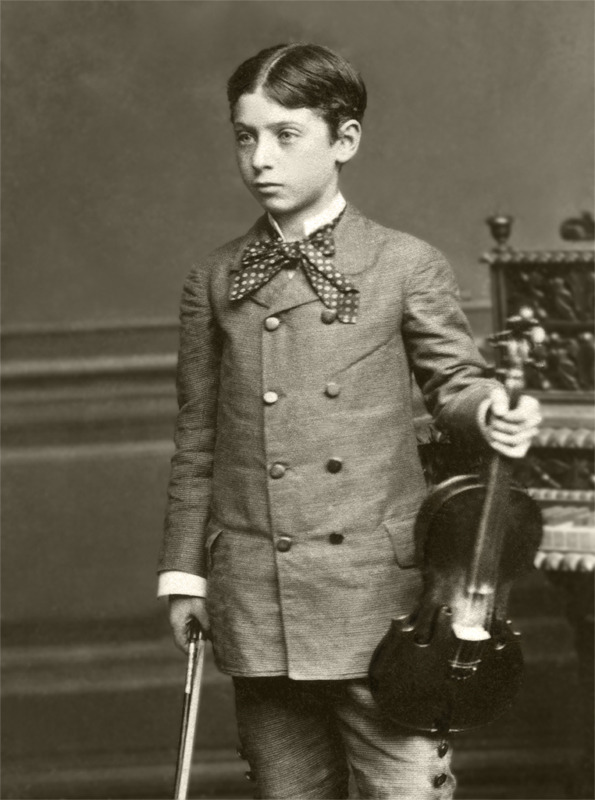
Moriz Glattauer was born in Vienna on January 16, 1870, the son of Samuel and Barbara Glattauer. He studied violin at the Vienna Conservatory from 1882 to 1886 under Josef Maxintsak, a member of the Imperial Hofkapelle and Court Opera Orchestra, and Joseph Hellmesberger Jr., violin soloist, concertmaster, and conductor of the Court Opera. He completed his studies with a diploma.
Glattauer joined the Vienna State Opera Orchestra and the Vienna Philharmonic on April 1, 1916, as a first violinist, a position he held until his retirement at the beginning of January 1938. He had three siblings: Emil, Ernestine, and Friedrich. His first wife was Rudolfine (née Hertzka, 1882–1906). He and his second wife, Anna Schidlof, married in 1915; the couple lived at Riemergasse 8 in Vienna's 1st district and were members of the Jewish Community of Vienna (Israelitische Kultusgemeinde).
Following the Anschluss in March 1938, Jewish musicians were barred from working and performing. They faced a succession of antisemitic measures — eventually totalling some 250 legal restrictions — that stripped away their professional and civil lives. From 1940 onwards, the Glattauers, like most Jews remaining in Vienna, were evicted from their home at Riemergasse 8 and forced into so-called "Jewish collective apartments," or "Jew House", where families were crowded into single rooms without adequate washing or cooking facilities. By the time of their deportation, their last recorded address in Vienna was Annagasse 3/7, also in the 1st district.
The Nazi leadership of the Vienna Philharmonic made representations to Walter Thomas, the General Cultural Officer of the Reich, and to Gauleiter Baldur von Schirach in an attempt to protect persecuted members of the orchestra. Schirach, who cultivated a reputation as a patron of the arts, was unmoved. His stated aim was to make Vienna free of Jews and Czechs. Five Philharmonic musicians and their families were deported; three of them, including Glattauer, were sent to the Theresienstadt ghetto.
Deportation and Death
On July 14, 1942, Moriz Glattauer, then 72 years old, was deported to the Theresienstadt ghetto northwest of Prague, together with his wife Anna, on transport IV/4 (no. 541). Theresienstadt functioned for the large majority of its prisoners as a transit point rather than a final destination. From there, mass transports were regularly dispatched to extermination camps including Treblinka, Auschwitz, and Maly Trostinec. Within the ghetto itself, conditions were severe: hunger, the absence of sanitation, and inadequate clothing caused the deaths of approximately 33,000 of the roughly 140,000 people deported there. A further 88,000 were transported to other extermination facilities and killed.
Moriz Glattauer died in Theresienstadt on February 2, 1943, at the age of 73. The recorded cause of death was Phlegmona faciei, a bacterial infection of the facial tissue. Anna Glattauer was transported to Auschwitz on May 15, 1944, on transport Dz, where she was murdered.
Commemoration
In 2022, the Vienna Philharmonic, under the initiative of its then-Chairman Daniel Froschauer, commissioned memorial stones to be placed in the pavements outside the former Vienna addresses of sixteen orchestra members persecuted under the Nazi regime. A stone commemorating Moriz and Anna Glattauer was laid in front of Riemergasse 8. A seventeenth stone was also placed in honour of Alma Rosé, daughter of Philharmonic violinist Arnold Rosé, who was killed at Auschwitz. Of the sixteen persecuted Philharmonic members, five were killed in the Holocaust, two died under life-threatening conditions in Vienna, and nine survived in exile.
Music and the Holocaust, 2026
Sources
-
Mayrhofer, Bernadette. Moriz Glattauer (Violin I). Vienna Philharmonic Historical Archive. Translated by Gloria McElheney. Available at: www.wienerphilharmoniker.at [Accessed 2024].
-
Jewish Community of Vienna (Israelitische Kultusgemeinde Wien), Department of Matters of Restitution. Records compiled by Sabine Loitfellner. Cited in Mayrhofer (see above).
-
Archives of the City and Province of Vienna. Historical residency records. Cited in Mayrhofer (see above).
-
Documentary Archives of the Austrian Resistance (Dokumentationsarchiv des österreichischen Widerstandes). Online database. Available at: www.doew.at [Accessed 2024].
-
Archives of the University of Music and Performing Arts, Vienna. Annual journals of the Vienna Conservatory of the Society of Friends of Music in Vienna. Records on Josef Maxintsak and Joseph Hellmesberger Jr. compiled by Lynne Heller. Cited in Mayrhofer (see above).
-
Vienna Philharmonic. Stones of Remembrance [press statement]. Vienna Philharmonic, 2022–2023. Available at: www.wienerphilharmoniker.at
-
Österreich Wiki. Moriz Glattauer. Available at: oesterreichwiki.org/wiki/Moriz_Glattauer [Accessed 2024].
-
Holocaust.cz. Moritz Glattauer (born 16 January 1870, Vienna; murdered 2 February 1943, Terezín). Database of Victims, victim ID 50867. Transport IV/4, no. 541 (Vienna–Terezín). Death certificate records cause of death as Phlegmona faciei. Available at: www.holocaust.cz/en/database-of-victims/victim/50867-moritz-glattauer/ [Accessed 2024].
Note: The holocaust.cz database contains a second entry under a near-identical name — Moritz Glattauer, victim ID 50868 (born 23 October 1872; last address Wien 20, Rauscherstrasse 5/19; transport IV/9, no. 529; murdered 4 December 1942, cause of death recorded as heart attack). Available at: www.holocaust.cz/en/database-of-victims/victim/50868-moritz-glattauer/ [Accessed 2024]. Cross-referencing birth date, last address, date of death, cause of death, and transport date with all other available sources confirms that victim ID 50867 is the Vienna Philharmonic violinist. Victim ID 50868 is a different individual.
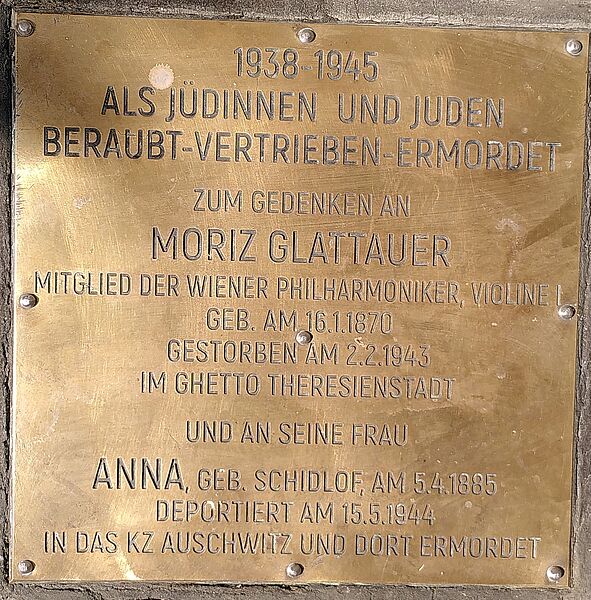
Stone of Remembrance for Moritz and Anna Glattauer in Vienna, Riemergasse 8, 1010 Vienna. Photo: Nils Münger